
Thonet No. 14: The Café Chair You’ve Sat In a Hundred Times
In 1859, Michael Thonet introduced what would become one of the most recognizable chairs in the world: the No. 14.
At the time, furniture was typically heavy, ornate, and difficult to produce at scale. Thonet approached it differently. Using a steam-bending technique, he created a chair that was lightweight, durable, and efficient to manufacture. It could be disassembled into a small number of parts and shipped flat, making it one of the earliest examples of a globally distributed furniture product.
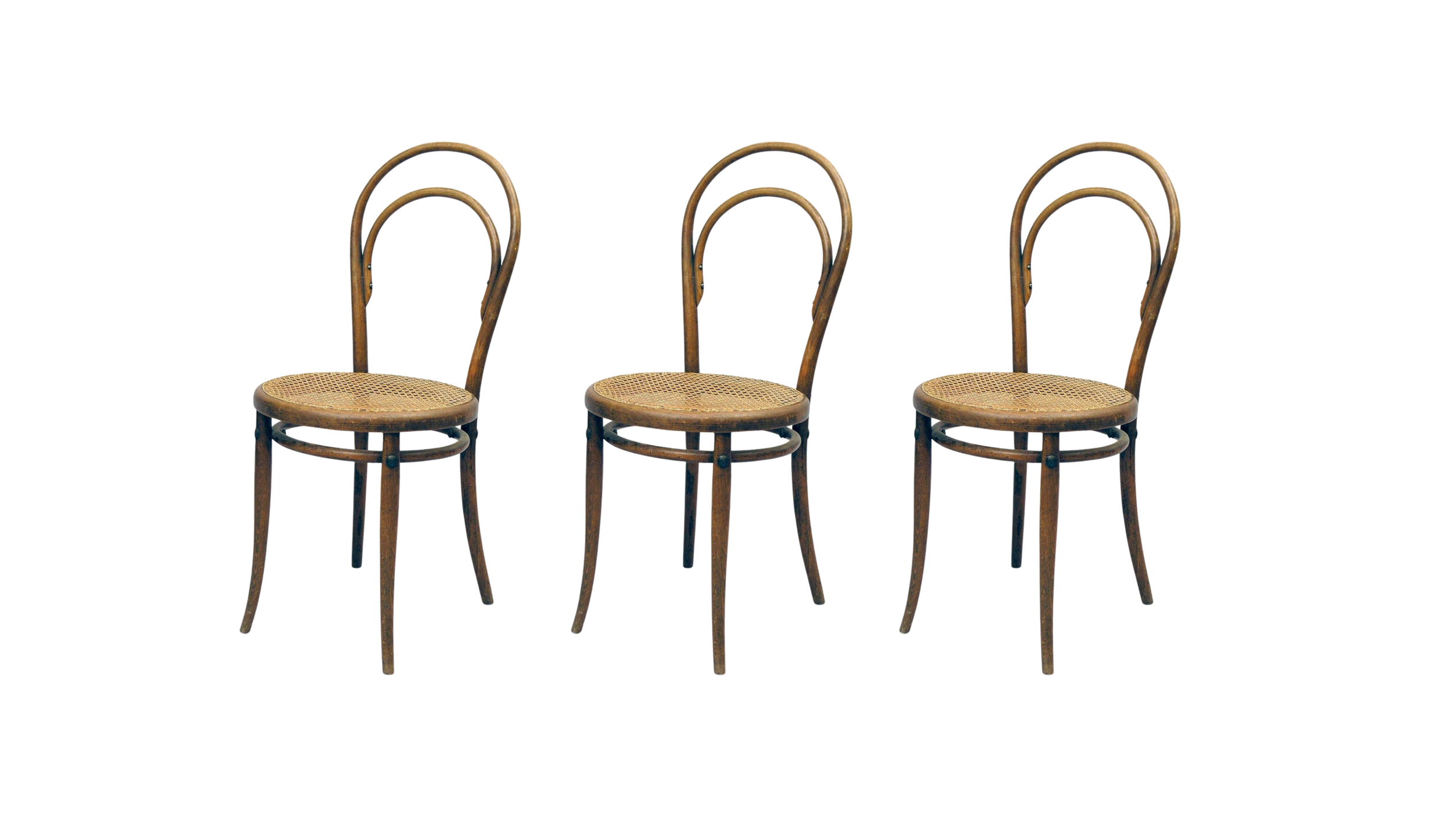
The structure was simple – six wooden elements, a handful of screws, and a woven seat. Nothing unnecessary, nothing decorative for the sake of it. Every part had a purpose, and that clarity is what made it work. It wasn’t trying to be revolutionary in appearance, but in many ways, it was.
Over time, the chair spread quickly. Within a few decades, millions were produced and distributed across Europe. It began to appear in cafés, restaurants, and public spaces – Paris, Vienna, Berlin, Budapest. It became part of the everyday environment, something people interacted with constantly without always noticing it. It wasn’t positioned as a design object. It simply fit.
That’s part of what made it lasting.
The chair was designed for real use. It needed to hold up through long days, constant movement, and repeated wear. At the same time, it carried a certain elegance. The curved back, the proportions, the restraint in its form – everything felt resolved. It didn’t compete with the space around it. It supported it.
It also became quietly embedded in culture. Pablo Picasso was known to sketch with one nearby, and Le Corbusier described it as a product of industrial precision. Today, it continues to appear in interiors and films, often used to create a sense of familiarity and balance. It’s not the focal point, but it’s almost always present in spaces that feel considered.
More than 160 years later, the No. 14 is still in production. It hasn’t changed much, and it hasn’t needed to. It remains sturdy, functional, and quietly distinct—the kind of object that doesn’t try to stand out, but consistently holds its place.
Through the Anoteka Lens
This is something we think about often when it comes to branding. Not everything that lasts is designed to be iconic. In many cases, it’s the opposite. The things that endure are often the ones that feel natural, well-resolved, and easy to live with.
They don’t demand attention, but they earn it over time.
The same applies to brands. The most effective ones aren’t always the loudest or the most complex. They’re the ones that feel considered, balanced, and clear. The ones that fit into people’s lives in a way that feels effortless, but still leaves an impression.
If you’re building a brand, it’s worth thinking about what makes something last – not just visually, but in how it functions and how it’s experienced over time.
If you’re ready to shape something more intentional, let’s explore it.